
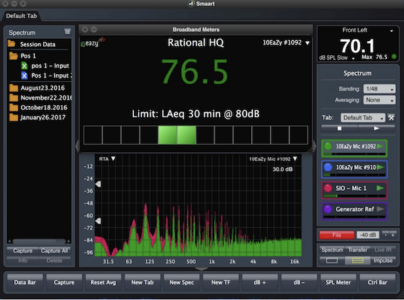
The 10EaZy Maximum Average Manager (MAM) provides an intuitive way of managing sound levels against a predefined Leq limit. Its display is simple, immediately understandable and widely appreciated by sound engineers and others involved in live sound production.
When designing MAM, 10EaZy founder and inventor Jacob Navne van Vliet had a clear goal: to give everyone involved in a production a tool that could be understood simply by glancing at it for a second.
The design is straightforward. There are six blocks on either side of a central reference point. The blocks on the left are red, while those on the right are green. Each block represents 1 dB.
Based on the Leq settings configured by the user, the 10EaZy algorithm calculates how many decibels have been used up or how much headroom remains within the specified limit.
Understanding Leq
Leq describes the equivalent continuous sound level over a defined period.
For example:
- 99 dB(A) LAeq,30min means an A-weighted equivalent sound level of 99 dB over 30 minutes.
- 103 dB(A) LAeq,15min means an A-weighted equivalent sound level of 103 dB over 15 minutes.
The reasoning behind these measurements is straightforward. Sound levels during a concert are dynamic. They vary considerably over time, and authorities want to establish sensible limits for the sound pressure levels to which audiences are exposed.
In my lectures, I often compare this with the average-speed measurements used on roads in Scandinavian countries.
For those unfamiliar with the system, a section of road, perhaps 10 km long, is monitored using two cameras. The first camera records the vehicle entering the monitored section, while the second records its exit. By comparing the timestamps, the system calculates the vehicle’s average speed. Drivers exceeding the permitted average speed can then be identified.
While driving through this section, it is not particularly easy to know whether you are still within the permitted average speed. A conventional speedometer only tells you your instantaneous speed, not your average speed over the monitored distance.
This is where a MAM-like functionality would come in handy.
Admittedly, the analogy is not perfect when examined closely, but it helps explain the principle behind Leq and why monitoring instantaneous SPL alone is insufficient.
What does MAM actually do?
MAM is designed to help sound engineers manage an accumulated Leq limit proactively rather than simply react to a measurement that is already approaching its maximum.
By defining a maximum Leq level, an averaging period and frequency weighting, MAM provides a visual indication of the available headroom or the amount by which the target is being exceeded.
The display is particularly intuitive. When the red blocks start appearing, you are using up your available sound level budget. As you reduce the level, the red blocks gradually disappear and the green blocks start appearing again, indicating that you are recovering headroom.
This gives the sound engineer direct control over the average SPL throughout a performance.
And this is where things get interesting from a mixing perspective.
You know your programme material. You know when the big chorus is coming, when the drums kick in and when the arrangement becomes quieter. During a ballad, for example, you can deliberately ease back on the overall level and save some of your available Leq budget for the more energetic parts of the show.
Rather than mixing everything at a relatively constant level to stay safely below a limit, you can use the available headroom intelligently.
In essence, SPL monitoring can actually help you mix more dynamically.
The objective is not simply to stay below a sound level limit. It is to make the best possible mix within that limit.
What can standard Smaart SPL do?
Smaart SPL already offers many of the tools needed for effective sound level management.
Using its configurable SPL metrics, you can:
- Monitor LAeq over a defined integration period, such as 15 minutes.
- Define custom SPL metrics and measurement parameters.
- Configure alarm thresholds.
- Monitor current levels alongside accumulated Leq measurements.
- Record and review SPL history.
With an appropriate configuration, this provides a practical monitoring solution for venues and live events operating under defined sound level restrictions.
What is the difference?
The important distinction is the dedicated MAM functionality provided through 10EaZy integration.
Standard Smaart SPL measures and displays the actual sound level statistics over the selected integration periods. Alarms can alert the engineer when predefined thresholds are reached.
MAM adds a dedicated calculation and visual representation intended to indicate how the current programme level relates to the remaining Leq budget.
In other words, conventional SPL monitoring tells you where your accumulated measurement stands. MAM adds an indication of where the current operating level is likely to take you.
What about the “Left Over SPL” display in RT Capture?
Some engineers, particularly in Sweden, may remember the Left Over SPL display in RT Capture.
Although it uses a similar visual concept of displaying the remaining sound level budget, it is fundamentally reactive rather than forward-looking indication.
RT Capture is also legacy software and should primarily be considered a historical reference rather than a contemporary alternative to Smaart SPL or 10EaZy MAM.
The distinction is important: displaying the remaining SPL budget is not the same as predicting how the current programme level will affect the final Leq result.
The real benefits of 10EaZy
Is 10EaZy necessarily required? Not if your requirements are limited to conventional SPL measurement, Leq monitoring, logging and threshold alarms. Smaart SPL can already handle these tasks.
However, if you specifically want the dedicated MAM functionality, the 10EaZy integration provides that additional capability within Smaart.
Another important aspect of 10EaZy is its approach to measurement integrity.
10EaZy is a locked measurement system. There is no possibility of altering the microphone gain, for example, and the measurement log files are protected against modification. This provides an additional level of confidence when measurements need to be documented and presented to authorities, venues or other stakeholders.
Over the years, 10EaZy has become a de facto industry standard in professional sound level monitoring. Its appeal is straightforward: no complicated setup, no specialist experience required. Install the software, connect the dedicated hardware, and you are ready to go.
The full-featured software offers considerably more than basic SPL monitoring:
- Comprehensive minute-by-minute measurement log files.
- Running Order functionality for adding production metadata.
- Event Log for keeping notes and documenting relevant events.
- Real-time analyser functionality, with 1/1-octave full-range or 1/3-octave low-frequency resolution.
- Integration with Smaart.
The last point is particularly interesting. You do not have to choose between the dedicated 10EaZy measurement environment and Smaart. Both can be used together through a single hardware platform.
Conclusion
Smaart offers SPL monitoring capabilities across its product range. However, recording and maintaining a documented measurement history using a calibrated microphone is a feature of Smaart SPL and the dedicated 10EaZy system.
Smaart SPL is available as standalone software or as part of Smaart v9 ST (Suite). Smaart runs on both Windows and macOS.
For forward-looking indication information about Leq within the measurement periods and limits specified by local regulations, 10EaZy MAM is the tool of choice.
10EaZy is a dedicated measurement system consisting of a factory-calibrated microphone and measurement hardware, ready to use when connected. Its standalone software runs on Windows, but the measurement system can also be integrated into a Smaart environment.
This combination offers the best of both worlds: dedicated, protected SPL measurement and logging, together with the extensive measurement and analysis capabilities of Smaart.
Products used for SPL logging
-
10EaZy
SPL Monitoring SystemPrice range: $ 2,250.00 through $ 2,499.00 -
8930 AZ Microphone Calibrator incl. Adapter for 1/4″ microphones
Original price was: $ 120.00.$ 110.00Current price is: $ 110.00. -
AUDIENT
evo seriesPrice range: $ 105.00 through $ 465.00 -
MELLab MYc-3
measurement microphoneOriginal price was: $ 425.00.$ 399.00Current price is: $ 399.00. -
MELLab T-60
60kHz measurement micOriginal price was: $ 895.00.$ 850.00Current price is: $ 850.00. -
MELLab TX-3
measurement microphonePrice range: $ 180.00 through $ 370.00 -
Smaart SPL
measurement softwarePrice range: $ 140.00 through $ 299.00 -
Smaart v9 ST
measurement softwarePrice range: $ 327.60 through $ 999.00



Upcoming Seminars
-

Private Smaart Class
in venue
by appointmentPrice range: $ 5,000.00 through $ 8,000.00 -

Smaart Online Workshop
via ZOOM
by appointmentPrice range: $ 150.00 through $ 250.00 -
Smaart Online Workshop
via ZOOM
every Wednesday$ 60.00 -
Smaart Z2H Seminar
KRISTIANSAND
22-25 February 2027From: Original price was: $ 999.00.$ 899.10Current price is: $ 899.10. -
Smaart Z2H Seminar
OSLO
24-27 May 2027From: Original price was: $ 999.00.$ 899.10Current price is: $ 899.10.

